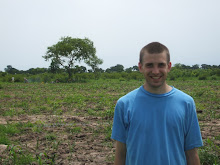
Saturday, June 20

It's been a while

Sorry for the long wait! I simply have not had access to the internet for two weeks! Last week we had our JF retreat as well as the country meeting, where all the EWB volunteers in Ghana come together to discuss strategy and share their lessons learned. So the weekend was taken up with meetings and discussions, leaving no time for the interenet cafe.

Thanks again for all the great comments, and a special thanks to the chapter for coming up with those great questions. I have only just read the email, so I won't be able to answer any of them now, because I would rather prepare a proper answer for each of them. I'll likely devote the next blog post (and possibly a second one) to answering the questions. I'll also post the questions below for everyone to read so that they can know what to expect.

Because of the lenght of time that's passed, I'll have to settle for giving you a brief overview of everything, instead of going in depth into any one thing.

So first of all was the JF retreat. Most of us met in Tamale on Wednesday and waited several hours for our bus to arrive and take us to Damongo, where we would spend two nights before visiting Mole National Park. The bus ride was long an fairly brutal, but while waiting and along the way I was encouraged to try lots of different foods, that I had been hesistant to try out because of a paranoia of getting sick. And so I tried a Ghanaian orange for the first time, and had some coconut, some sugar cane, and most exciting of all... fried cheese!!! Best of all, none of them made me unwell! The road was so bumbpy it made your voice vibrate as you spoke, too bad the person next to you couldn't hear it over the clanging of the bus. We arrived in Damongo and began with short presentations from each of the JFs on thier placement. We were then given updates on some big changes that are in the mix for EWB. They include overall structural changes for the entire organization as well as changes to how things operate in West Africa and in Ghana. One big theme was the need for increased communication, between all parts of the organization. After sharing some of our chalenges and successes and offering advice to one another we set off for Mole National Park, where we saw elephants, warthogs, baboons, and crocodiles!

After the National Park we travelled back to Tamale to meet with the Long Term Volunteers. The ride was terribly long and we were all exhausted when we arrived, desperately in need of sleep. The next day we began more discussions and workshops. We learned about our different influencing styles. Turns out I'm an Expressor (surprised?). Appearantly I prefer to rely on feelings when making decisions and like to embellish stories to make them have more impact, the best role for me from a "management" point of view is motivation! We discussed strategy with the Long Terms and learned more about each of their specific placements.

On Monday, after that was all over, I headed home to Pong-Tamale. Once there I started to notice and rumbling in my tummy. Lets just say I was quite unwell for the next two days or so and was cursing whichever meal it might have been that had made me sick. I knew it wasn't any of the expiraments from the trip to Damongo because that was too long ago.

It made me think of a diagram that I had seen on another EWB volunteers blog. This diagram shows all the different ways faeces can get in your mouth! Yum!

Somewhere along the line, one of those barriers wasn't there. Maybe something wasn't cooked well enough. Had I washed my hands well enough? Maybe flies landed on the food.

Either way I was out of commission. And at a terrible time as well, there were only two days left before all the students went home for the summer. I had fully recovered by Thursday, just in time to attend the college's closing ceremony. So I said goodbywe to all the students I had met, and acted as official photographer for the two students who won awards of academic excellence.

My time since then has been focused on preparing things to move into my new place. I have a lock on the door now, and I'm in Tamale to buy a mattress and a fan. With luck I'll be living there by Monday!

And finally here are the questions from the chapter. The next time you hear from me I should have the answers to at least half of them.

1) What types of people are attending the college you at working at? - background/sex/age/numbers etc
2) What do you consider to be the greatest communication obstacle in your placement so far (if any)?
3) Is the government encouraging a certain type of entrepreneurship?
4) What happened to your laptop?
5) How is your host family?
6) What are the major differences in schools in Ghana and here in Canada
7) What ideas/principles learned, while working with EWB in St. John’s have you been able to usefully apply while working in Ghana?
8) In the short amount of time you've been there, do you feel like you’re already having an impact? if so, how do you plan to add on to it?
9) How are you adapting? Do you feel like you are experiencing any culture shock?
10) What parts of the culture are you finding really interesting? What are most surprising to you?
11) We know that you were involved with fair trade before you left, has your point of view changed since you have been there?
12) Do most people speak English as well as those at the college?
13) What is your most exciting experience so far?
14) What's available to do at the college in terms of academics? How similar is the teaching (style, depth) to say, MUN?
15) How much of an initial shock was there? How long did it take to get over?

Saturday, June 6

One on one

I've have been able to learn so much this week.

I've been interviewing students one on one, asking about their future plans and getting suggestions on how to develop entrepreneurial skills, among other things. Some students have absolutely blown me away.

Some students offered valuable insights into how students learn best, and on how to develop the best program to teach entrepreneurial skills. Others shared with me their exciting ambitions for the future, and still others provided concrete examples of youth entrepreneurship. Ibrahim, for example, explained how he had purchased one young bull and fattened it and then sold it, in order to get enough money to buy an older bull. This he fattened as well in order to make enough to buy two bulls. He continued doing this until he had four bulls, which he sold so that he could afford to write the exams and come to Pong-Tamale Vet College at the age of 30.

Abdul in particular, age 25, amazed me with his story of perseverance and determination. We sat down on a bench just outside the male dormitories as the sun was retreating behind the trees on the horizon. The bench was uncomfortable and I struggled to keep all my papers in place as the breeze flicked them around. This was soon forgotten as Abdul explained that, "Yes." he did have experience in entrepreneurship. As a result of his father's death, which happened while Abdul, an only child, was still in second grade, he had to find money on his won to cover his school fees while in junior high. To do this, he learned how to repair shoes, purchased a small show repair kit, and and visited homes in his community, fixing shoes for a small price. Then, before completing junior high, Abdul's mother died. Abdul was completely on his own and started a small field of corn, which he sold so that he could go to high school. Abdul was actually the only person in his community to have completed primary school, let alone pass high school and be accepted into a college.

As Abdul continued his narrative, I could only nod slowly as I felt the faint stirrings of tears in the corners of my eyes, which I fought back in order to avoid embarrassing Abdul, who was stoically sharing the facts of his life. He explained, "In Ghana, to save money, you must starve." Illustrating how he had been forced to cut back significantly on his diet in order to save enough money to start another small corn field, which was supporting him while he was at college. He wished to counter the view that massive amounts of capital are required to start up small businesses, he explained that you simply had to save and start very small. And he explained the most important thing was to be independent and passionate about reaching your goals. He then told me that he simply wanted to establish his own commercial livestock farm after graduation. He also wanted to return to his community to encourage young people to finish school. He thought that he could serve as an example that the only thing required to succeed was determination and a refusal to quit.

When he had finished, I was stricken and could barely bring myself to continue on to the remaining questions. As the strength of the sun was dying, I jotted down his thoughts on youth groups and developing entrepreneurial skills in students. Then when he asked for my number in Canada so that we could stay in contact, I could hardly refuse, he had fascinated me and blown me away with his strength of character. I would be honoured to be able to share as we both continued on our own journeys.

Sunday, May 31

Wintanga a yaya

Thanks so much for the wonderful comments on my last post, I'm glad you enjoyed. I'm not sure I'll be able to continue to impress you, but I feel as though I have to try.

Writing them on paper might be a good idea, but with the help of Moses at the office I've discovered that I can just use one of the monitors in the office and use my laptop as if everything was normal! Although I still can't use it outside the office. At the same time I didn't discover that early enough to prepare a post in advance, so this one will a be "on the fly".
I'm trying to arrange one-on-one discussions as we speak. I've made up a basic structure with some key questions that I'd like answered. And hopefully through that interaction I can get a clearer idea of the environment they find themselves, with more specifics.
As well, I wasn't in Accra, so I apologize if I said that somewhere, it was a mistake. The internet cafe that I'm using is in Tamale, about a 25 minute drive from Pong-Tamale. I will be spending most of my time in Pong-Tamale, only coming into Tamale on weekends. I hope to elaborate a bit more on my attempts to find a permanent residence later in the post. As for the compounds that you likely saw from Google Earth, each of those would generally house a family. I'm not 100% sure about the functions of the larger buildings and smaller huts, because I believe it varies from family to family. Generally, though, I think the larger rectangular buildings will house the head of the household and in many cases has other rooms for other members. The other huts can serve many functions it seems, usually as a room for sleeping but some are the entryway to the compounds. Once I find a compound of my very own I'll provide the layout.

So this week was a bit different than my previous ones, it presented me with my first truly tangible pangs of home-sickness, a drop in motivation and general frustration with the difficulty I've had communicating with those around me. It was a bit up and down. I would have a day of feeling more or less useless and then start to feel better the next day, and then the next day I'd be down again.

I'm feeling fine now, and today in fact was quite fun, but I'll save that for the end. This week was difficult for a number of reasons, many little things compounded together to appear much more frustrating than they should have been. First of all, I was thinking that things at work were moving to slow, and that I wasn't pushing myself enough to keep up momentum. I was banking on my interactions with the students this week to act as my springboard to jump into the coming week, but on both Wednesday and Thursday, the students failed to arrive. It turns out that there was a scheduling mistake and they had been asked to meet with me on the two days leading to a deadline to fill out some important paperwork in Tamale. But even given this, it still didn't feel good to think that I had wasted two afternoons waiting for them, and that I was unable to make the preparations I was hoping to make for the following week.

This let-down was added to my inability to make any progress in finding a home in the community, so that I could begin the process of attempting to understand the local people and their livelihoods in earnest. I hadn't felt that I was properly communicating my need to live in the community to the Principle of the College, with whom I was staying. And in truth I had no idea where to begin, I was simply going to have to stroll into the village and start asking.

A stroke of luck came with the intervention of an extremely helpful individual by the name of Rahman. Thanks to a call from Sarah my coach to the Vice-Principle, as well as the subsequent conversation that he and I had, the Vice-Principle had asked Rahman, a young man of 25 who lived in the community to give me a hand. Rahman and I had met before, he had helped get my bicycle ready for use. Rahman had immediately spread the word that I was looking for somewhere to stay and the following days were spent meeting all the individuals who had a room to spare. Rahman had presented me with more options than I could handle.

So the prospects of finding a suitable place to stay in the community are now much better than they were at the beginning of the week, and I've been able to give myself the extra push to realize that I can and should just pursue the things I'm hoping to accomplish at work, such as interviewing teachers, rather than waiting for something to just happen on its own. The important thing was to get past the fear of feeling annoying!

And now on to today! Adam and I had arranged earlier in the week to go farming with his host family. So this morning I woke up bright and early and caught the first tro-tro (a large bus-like van) for Tamale. After a breakfast of egg-and-bread (literaly fried egg squished between a bun) and a mug of Milo (hot chocolate) I joined Adam and his friends Yussif and Ibbrahim outside their compound and we jumped onto bicycles to make the journey to the farm. It wasn't exactly a comfortable one since I was riding on the rear rack of the bicycle and could feel every bump and rock! After one small tumble caused by mud, we recovered and arrived at the large rectangle of earth that we would transform into a maize field by spreading seed.

Yussif and two others traversed the field back and forth poking holes in the group for the seed with large sticks, than Adam, the rest of the boys and I walked behind them tossing seeds into each hole and covering them in soil with our feet.

It wasn't that tiring but the sun began to take its toll, calling for lots of water! Eventually we were joined by the women of the family, and they joined us in the sowing of the seeds. It took surprisingly little time to cover quite a bit of ground. The family laughed at Adam and I as we sweated and applied and re-applied sunscreen. This prompted the phrase "Wintanga a yaya"

The sun turned out to be too much for the entire operation by the time 2:00 rolled around, because it had dried out the soil, and it was no longer productive to continue sowing. And thus ended my first farming experience in Ghana.

Saturday, May 23

Life at the College

Hey folks,

First and foremost, I would like all of us to mourn the death of my laptop. Well it's likely salvageable but probably not until I return to Canada. The screen has been rendered useless. And so can only write updates while actually at the Internet Cafe instead of writing them ahead of time and then uploading as I had hoped. This will result unfortunately in unedited updates, likely of a lesser quality than the ideal. So please bear with me. The other more tragic is result is that I see absolutely no way to upload pictures!!

So I have started work at the college, as my last post explained, but I'd like to give you a glimpse into one morning at the college.

I am waiting in a classroom with about thirty-five desks scattered around and two small whiteboards fastened to an old blackboard to make one usable whiteboard. As I wait, sweating in the heat young men and women slowly start to filter in to the classroom. As they do they begin re-arranging the desks into neat rows and they wipe down the desks to remove the dust that covers everything in this dry climate. While my back is turned looking out one of the doors to see if more students are coming, one of the students who was first to arrive has arranged one of the desks at the front of the class for my bookbag and has placed a whiteboard marker and eraser there for me to use. Surprised I thank him and he smiles and returns to his desk.

All the students are in uniforms. White shirts and brown slacks for the boys and blue dresses with white trim for the girls. There are about twenty-two boys present and three girls. The students are already joking and teasing each other as they settle in and I can tell this is a friendly environment where almost everyone is comfortable with everyone else. They are all paying extremely close attention as I introduce myself and explain my purpose for being there. I ask if they are having trouble understanding me, because being from where I am, I may have a tendency to mumble or speak too fast. They say they understand just fine, and this turns out to be true as we get deeper and deeper into discussion as I rarely have to stop and explain something I've said. I however have a somewhat harder time understanding what a few of them are saying, especially the shyer ones who speak quietly.

I write the word "entrepreneur" on the board. I ask what does it mean to be an entrepreneur. My goals for this discussion are twofold, EWB wants to know what the student's existing attitudes and understandings about entrepreneurship, and the college wants the students to spend some time thinking and learning about entrepreneurship. While I'm absolutely certain that I have absolutely nothing to teach the students about entrepreneurship, I do feel confident that a group discussion about it can provide the first steps for both the aforementioned goals. I will be able to learn what they think when they think entrepreneurship, and the students will share and debate with each other about the topic.

It quickly becomes clear that these students know a quite a bit about entrepreneurship and have a great deal to say on the topic. I write on the board all the different qualities that they say an entrepreneur has and all the things they say that an entrepreneur does. It was an entertaining and illuminating discussion. The students were eager to participate and share and I quicly became aware of some interesting class dynamics.

We then moved the conversation to the topic of "obstacles". I wanted to get a picture of what the students saw as standing in the way of starting up small businesses. If I thought they had a lot to share with the first topic than they were overflowing with input on this topic. The number of things they were able to identify was astounding. We discussed everything from an unstable economy and political instability to a scarcity of resources, disaster, conflict among partners and the perception of risk.

It was clear that these students had all the ideas and attitudes that I felt it would take to be successful entrepreneurs, but they simply do not find themselves in an enabling environment. Fortunately more entrepreneurship makes room for more entrepreneurship. So maybe as more young people take that risk and are successful, it will contribute to creating an environment in wich it is less dangerous for others to attempt. Unfortunately, however, that sort of risktaking alone will not ensure success, nor will it work in every environment. For real success governments like that of Ghana need help to invest in the necessary infrastructure and services that business require to be successful. That sort of help needs to come from the international community, and it will only happen as a result of pressure of citizens. So, get to work!

Thursday, May 14

Hitting the Ground Running

I know, I know. It's been far too long since my last update.

Some of you may have been disappointed, some of you may have even been worried. But I assure there is nothing to worry about, and I do apologize for failing to keep you up to date.

Things here in Ghana have been hectic since landing in Accra.

We arrived just in time to get a night's sleep, and were up early the next day to grab a bus to Tamale. That bus then broke down on the way, and we had to wait four hours for another bus. We arrived in Tamale late in the night, and slept a little before getting up to start meeting the Overseas team. We spent the day talking about culture, health and safety, and then we were sent on a scavenger hunt to get some extra things we will need. The next day was an intensive day of learning with our sector teams, so my group learned all about our strategy with MOFA (Ministry of Food and Agriculture) and our Agriculture As A Business (AAB) program.

Most JF's left the next morning for their various placements, but a few of us had to wait because our partners were not yet ready to meet. Two other MOFA JFs (Junior Fellows) and I were invited to a Regional MOPA meeting. That was quite an interesting experience. It was valuable to witness these Government employees discuss the various issues that affect them and their work.

Then, since I would not be travelling to Pong-Tamale yet, Sarah, my coach, arranged for me to go to the field with some extension agents to observe their use of the AAB curriculum. It was quite a learning experience! I learned quite a bit about chilli pepper farming, raising guinuea fowls, and fishing from my three visits. I also learned quite a bit about the three extension agents' different approaches to working with farmer groups.

So despite the fact that I haven't yet even started my placement, it has been non-stop since arriving!

I hope I can keep you up-to-date more regularly in the future.

Until next time.

Evan

Tuesday, April 28

Pre-Departure Training

Hey everyone!

The journey has begun. I'm sitting in the EWB house in Toronto, also known as Akwaba House, getting to know the other Junior Fellows!

The past couple weeks have been more or less a roller coaster, involving huge moments of excitement and major incidents of fear and discouragement. But overall it's been thrilling! The notion that I've been preparing for a four month visit to Ghana has been next to impossible to come to grips with. It's slowing becoming more and more real.

This week will be packed full of learning! We'll be doing workshops, discussions and training just about nonstop with the aim of building on the preparation that we've been doing for the last four months. Then on May 5th we will fly through Rome to Accra, the capital of Ghana.

From Accra I will travel to the Northern Region capital of Tamale and from the to the village of Pong-Tamale in the District of Savelugu Nanton. In Pong-Tamale I will be partnering with the Pong-Tamale Veterinary College. We will be working with the Ministry of Food and Agriculture (MOFA)to assess how the college relates to our Agriculture as a Business curriculum.

This college is one of the places in Ghana where Agricultural Extension Agents are trained. These are individuals who work to bring government programs to rural farmers. This can include new technologies, farming techniques, crops, etc. EWB has partnered with the MOFA to develop the Agriculture as a Business program which aims to help rural farmers take advantage of opportunities in a more productive way. By encouraging the creation and imporovement of farmer groups the program seeks to facilitate group projects or investments that will hopefully build upon the strenghts of the group.

The successful application of this curriculum benefits from an Extension Agent with certain kinds of Knowledge, Skills, and Attitudes. One of my major aims will be to discover what Knowledge, Skills, and Attitudes are developed at this Veterinary College and to determine if there are any significant gaps between the ideal Knowledge, Skills, and Attitudes needed for the the program and those developed at the college. Then we can start expirementing ways to bridge those gaps.

So there is a quick update of how things are going, and a descriotion of the work I will be doing this summer. There are a bunch of other things that I will be trying out, but that's the main goal right now, and I will update you when some of the other things become more relevant.

So please let me know if you want anything clarified (there are no questions too foolish, I tend to leave our major things in my explanations), or of anything excites you and you want to hear more.

Hopefully I will be able to tell you a bit more about how things are going here in Toronto later in the week. Until then!

Monday, March 16

Welcome to my Blog

Welcome

This blog will be your one stop shop for all updates and happenings related to my summer in Ghana.

I am one of two Junior Fellows from the Memorial University chapter of Engineers Without Borders (EWB). I will be traveling to Ghana as part of EWB's Junior Fellowship in International Development. I will be overseas for about four months. During that time I'll team up with some long-term EWB volunteers and the Ministry of Food and Agriculture to work on a program called "Agriculture as a Business." Keep tuned for an update on what this work will consist of, and for more info on EWB's overall strategy for this program.

I guess before going any further I should tell you a bit about myself, although I can probably say with some confidence that my one reader (Hi Mom!) probably already knows a fair bit about me.

As you may have gathered, my name is Evan Walsh. But you might want to know more than that, so...

I'm a second-year Political Science student at Memorial University of Newfoundland (MUN). I live in St. John's on a dairy farm and I volunteer with the MUN chapter of EWB (get used to acronyms!). I have a huge interest in social justice and international development and by extension topics like international politics and political philosophy.

Engineers Without Borders (which is not just for engineers) is a Canadian nongovernmental organization (NGO) that is committed to eradicating poverty. Poverty, though, is not about weakness or a lack of skill. It is a lack of opportunity. It is this need that EWB tries to address in its work overseas and at home in Canada. For more information in EWB and its work, please follow the above link.